
By The Dhaka Times Staff Correspondent
Bangladesh’s major industrial groups are increasingly turning to rooftop solar power as rising energy costs, fuel shortages and pressure from international buyers to reduce carbon emissions drive investment in renewable energy.
The combined generation capacity of rooftop solar power systems installed at various industrial establishments across the country has already surpassed 600 megawatts (MW). Most of these installations are at export-oriented garment factories.
Major Industrial Groups Expanding Solar Investments
One of the country’s leading industrial groups, DBL Group, has installed solar power systems with a combined capacity of 5.5MW on the rooftops of seven garment and textile factories. The group plans to install another 16MW at 10 factories, including ceramic and garment facilities. Around 8MW of the planned capacity is expected to become operational this year, with the remainder scheduled for next year.
DBL Group Vice Chairman MA Rahim said the company is investing rapidly in solar power due to concerns over energy security and pressure from foreign buyers to reduce carbon emissions.
According to company officials, rooftop solar power at their factories costs around Tk 6 to Tk 6.50 per unit, making it significantly cheaper than grid electricity in many cases.
Other major industrial groups, including Abul Khair Steel, Walton, Ha-Meem Group, PRAN-RFL Group, BSRM, Youngone Group, Meghna Group of Industries, Pacific Jeans Group, Team Group, Rising Group, Urmi Group, Microfiber Group, Palmal Group, Apex Footwear, Karnaphuli Shoe Industries and Masco Group, have also installed rooftop solar systems at their factories.
Rooftop Solar Capacity Could Reach 1,000MW
The rapid growth of rooftop solar can be gauged from a recent report by the US-based Institute for Energy Economics and Financial Analysis (IEEFA).
According to the report, government data shows that Bangladesh had 418.1MW of rooftop solar capacity as of June 2026. However, IEEFA estimates that the actual capacity had reached approximately 667MW across 239 establishments, including groups of companies.
If installations below 0.15MW are included, Bangladesh’s total rooftop solar capacity could already be around 1,000MW.
The expansion of rooftop solar has also contributed to a slight decline in daytime electricity demand, according to the report.
PRAN-RFL, Akij Bashir and MGI Increase Capacity
PRAN-RFL Group plans to generate more than 100MW of solar power from the rooftops of its factories. The group is already generating around 35MW at 20 factories, with at least another 30MW expected to be added this year.
Two of the group’s factories are also supplying electricity to the national grid.
Akij Bashir Group is another major investor in rooftop solar. Its Janata Jute Mills has a 21MW solar generation capacity and is meeting 100 percent of the mill’s electricity demand from rooftop solar.
At Akij Glass’s factory in Habiganj, a 13MW solar power system has been installed along with an 8MW battery storage system, allowing the factory to use stored solar electricity at night.
Akij Bashir currently generates around 75MW of electricity from rooftop solar systems and is working to add another 28MW.
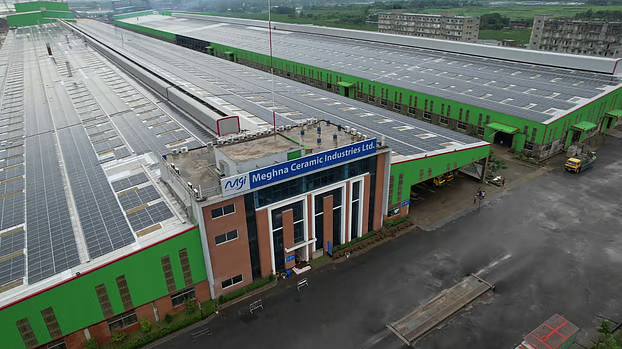
Meanwhile, Meghna Group of Industries (MGI) has installed solar systems with a combined capacity of 64.84MW at its factories. These systems currently meet around 5 percent of the factories’ electricity demand.
MGI plans to install another 50MW, which would bring its total rooftop solar generation capacity to approximately 115MW.
Solar Power Cuts Industrial Electricity Costs
Rooftop solar is becoming increasingly attractive to industrial entrepreneurs because of its lower generation cost.
Electricity currently costs around Tk 12.73 per unit for small industries. For large factories, the average rate is around Tk 12.85 per unit for medium-voltage connections and Tk 12.75 per unit for high-voltage connections.
During peak nighttime demand, electricity prices can approach Tk 16 per unit.
By comparison, rooftop solar power can be generated at approximately Tk 4 to Tk 8 per unit.
Leading garment manufacturer Rising Group has installed 14MW of rooftop solar capacity across six industrial facilities. Solar power supplies up to 60 percent of the electricity demand at two garment factories, while around 15 percent of demand at two spinning mills is met through rooftop solar.
The company’s Managing Director Mahmud Hasan Khan said solar power was initially installed to address gas shortages but later became an important business investment because of its lower generation cost.
Solar Companies Expanding Their Projects
Omera Solar, a subsidiary of East Coast Group, has installed rooftop solar systems with a combined capacity of around 130–140MW at 100 industrial facilities since 2021.
The company is currently installing systems at another 12 industrial facilities, which are expected to add approximately 20MW of generation capacity.
Superstar Renewable Energy has implemented rooftop solar projects at around 90 industrial facilities, with a combined capacity of approximately 100MW. It is currently installing systems at more than 10 additional facilities, which are expected to generate another 20MW.
According to the company, the cost of installing a 1MW rooftop solar system has fallen from around Tk 50 million five years ago to approximately Tk 40 million today. By comparison, installing the same capacity on the ground costs close to Tk 80 million.
Financing Remains a Major Challenge
Despite growing interest, limited access to financing remains one of the biggest obstacles to expanding rooftop solar, particularly among medium-sized industries.
A recent BGMEA survey of 424 garment factories found that all the factory owners expressed interest in installing rooftop solar systems. However, they identified financing constraints as the main barrier.
Some garment manufacturers also face increasing pressure from European Union buyers to reduce carbon emissions from production by 30 percent by 2030.
Loans for solar installations are available at around 5 percent interest through Bangladesh Bank’s Green Transformation Fund and 6 percent through IDCOL. However, obtaining IDCOL financing requires a 100 percent bank guarantee, making it difficult for many medium-sized entrepreneurs to access the funds.
Bangladesh Has Significant Solar Potential
A study by the Centre for Policy Dialogue (CPD) estimates that Bangladesh could generate approximately 1,768MW of solar power from the rooftops of 3,320 garment factories.
Around 500 factories are reportedly ready to begin solar power generation, while another 1,300 could potentially start generation quickly if appropriate incentives are provided.
The government has set a target of increasing the share of renewable energy in the country’s total electricity generation to 20 percent by 2030. It has also withdrawn several duties and taxes on imports of key solar power equipment during the current fiscal year.
Industry officials believe these measures could reduce the cost of installing solar systems by around 15 percent. The cost of installing 1MW could potentially fall from around Tk 40 million to Tk 35 million.
Experts say expanding rooftop solar across Bangladesh’s industrial sector could help reduce production costs, improve energy security, ease pressure on the national grid and lower carbon emissions.
However, they stress that greater access to low-cost, long-term financing will be essential if rooftop solar is to expand beyond large industrial groups and reach small and medium-sized factories.