
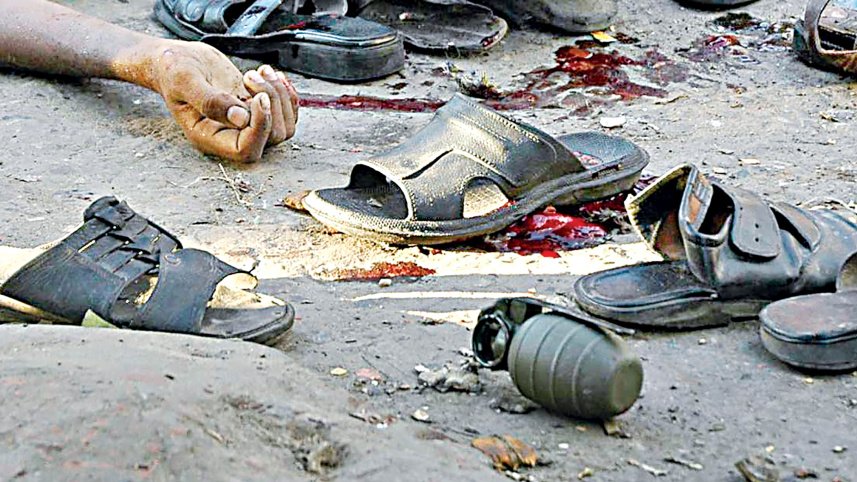
Twenty-two years after the August 21 grenade attack, the case remains one of the most consequential unresolved cases in Bangladesh’s history.
The attack on an Awami League rally that day in 2004 in Dhaka killed 24 people and injured nearly 300. Yet, despite years of investigations, conflicting narratives under successive governments, and death sentences for dozens of accused, no one stands criminally convicted.
In October 2018, Dhaka’s Speedy Trial Tribunal-1 sentenced 19 people to death, including former state minister for home affairs Lutfozzaman Babar and former BNP deputy minister Abdus Salam Pintu, while 19 others received life imprisonment. Pintu, currently a BNP vice-chairman, maintained his innocence.
Those convictions, however, did not survive judicial scrutiny.
On December 1, 2024, the High Court acquitted all surviving accused and recommended a fresh investigation, ruling that the supplementary charge sheet had been submitted directly to the trial court instead of the magistrate concerned. Thus, the trial court had taken cognisance illegally, and the entire proceedings rested on a legally defective foundation.
The HC also found that none of the 225 prosecution witnesses had seen who threw the grenades or planned the attack, meaning the convictions were largely based on hearsay.

The HC further held that Mufti Abdul Hannan’s second confessional statement, a cornerstone of the prosecution’s case, was seriously compromised because it was recorded four years after his first confession.
The acquittal became final on September 4, 2025, when the Appellate Division upheld the HC verdict and removed its recommendation for a fresh investigation.
The apex court expressed serious doubts about the voluntariness of the confessional statements, noting that three accused had confessed before the same magistrate on the same day “with unusual haste in gross violation of the prescribed rules”.
“The circumstances under which the confessional statements of the accused were obtained have given rise to serious doubt about their voluntariness,” the court observed.
It also noted that several accused had been kept in prolonged police custody without magisterial authorisation before their statements were recorded.
The court took particular note of Hannan’s second confession and the fact that he could never be cross-examined, having been executed in 2017 in the 2004 grenade attack on the British high commissioner in Sylhet.
Senior criminal lawyer Manzill Murshid said, “The government could still seek a review under the Supreme Court Rules.”
4 GOVTS, 4 NARRATIVES
The Supreme Court’s verdict closed a case that evolved dramatically under four successive administrations: the BNP-led government, the military-backed caretaker government, the Awami League government, and the Prof Muhammad Yunus-led interim government.
Each phase produced new allegations, revised findings, supplementary charge sheets and additional accused, raising questions about the independence and credibility of the investigations.
Ultimately, the lower court proceedings failed to satisfy the legal standards applied by the higher courts, leaving the attack without a single criminal conviction.
On August 21, 2004, then opposition leader Sheikh Hasina had just finished addressing a rally from an open truck converted into a stage when several military-grade grenades were hurled into the crowd, apparently targeting the stage.
Hasina narrowly survived but reportedly suffered permanent hearing damage. She later served as prime minister for 15 years before fleeing the country on August 5, 2024, following a mass uprising.
 For all latest news, follow The Daily Star’s Google News channel.
The first investigation unfolded under the BNP-led government.
The Criminal Investigation Department arrested Jamal Ahmed, widely known as Joj Mia, on June 10, 2005, along with 19 others.
The case later collapsed.
After being released in July 2009 following a fresh investigation initiated under the 2007-08 caretaker government, Joj Mia told The Daily Star that CID officers had tortured him, threatened to kill him in a staged “crossfire” and forced him to confess.
He said investigators instructed him to implicate members of the alleged Seven-Star criminal group led by Subrata Bain, promising financial support for his family and a new life abroad.
When those payments stopped after six months, his relatives disclosed the arrangement to the media, severely undermining the credibility of the investigation.
The investigation changed course in 2007 when CID Assistant Superintendent Fazlul Kabir replaced investigating officer Munshi Atiqur Rahman.
Fazlul concluded that leaders and operatives of the banned militant outfit Harkat-ul-Jihad al-Islami (Huji) had orchestrated the attack.
His charge sheet, submitted on June 9, 2008, said Atiqur had questioned Huji chief Mufti Abdul Hannan in November 2006 while Hannan was in custody in another case.
According to the report, Hannan disclosed information about several militant attacks, including the Ramna Batamul and Udichi bombings, the Sylhet grenade attack on the British high commissioner, attacks on Awami League leaders, and an earlier plot to kill Sheikh Hasina.
Fazlul later interrogated Hannan, his brother Mahibullah alias Abhi, Sharif Shahidul Alam Bipul and Maulana Abu Said alias Dr Zafar. According to the charge sheet, all four confessed before magistrates to planning and executing the attack with others.
He eventually charged 22 people, including Hannan, Pintu and Pintu’s brother Maulana Tajuddin, portraying the attack as a militant operation carried out with local political support.
‘STATE-BACKED CONSPIRACY’
After the Awami League returned to power in 2009, the prosecution sought a further investigation into the source of the grenades and financing behind the attack.
The court granted the petition and Abdul Kahar Akand, a retired CID officer reinstated as a police superintendent, was appointed as the investigating officer.
Kahar had previously investigated the assassination of Sheikh Mujibur Rahman and was later promoted to additional deputy inspector general of police. He also received an Awami League nomination in the 2024 parliamentary election.
During his investigation, Abdul Majed Butt, an operative of the Kashmir-based militant outfit Hizbul Mujahideen, confessed that Tehreek-e-Jihadil Islami leader Muzaffar Shah had sent two cartons of grenades to Bangladesh for shipment to Kashmir.
According to court documents, Mufti Hannan forwarded some grenades to India while keeping others with Maulana Tajuddin.
The investigation took a more dramatic turn in 2011.
On April 7 that year, Mufti Hannan voluntarily made a second confessional statement, alleging that the Hawa Bhaban, senior BNP leaders and members of state security agencies had been involved in planning the attack.
The defence argued that the statement had little evidentiary value because it was recorded four years after his first confession while he was awaiting execution.
In July 2011, CID submitted a supplementary charge sheet adding 30 more accused, raising the total to 52. The new list included several senior BNP and Jamaat figures, shifting the prosecution’s theory from a militant-led operation to a broader state-backed conspiracy.
DEFENCE CHALLENGES
Defence lawyers argued that the expanded conspiracy rested on unsubstantiated claims.
Lawyer Mohammod Zaynul Abedin Mesbah said the supplementary investigation alleged that Huji leaders had visited Hawa Bhaban, but no witness substantiated the claim.
“As a lawyer, I would say the trial court proceedings were unfortunate for Bangladesh’s judiciary. At the time, the judiciary often looked towards the government in power,” he said. “The court delivered a judgment in line with what the government wanted.”
Another defence counsel, Nazrul Islam, cited the case of Abdur Rashid, a former Al Markazul Islami Bangladesh leader, who gave a judicial statement in May 2011 claiming he had accompanied Hannan and other Huji leaders to Hawa Bhaban in mid-August 2004.
According to Nazrul, Rashid later said at a press conference at the Jatiya Press Club he had been tortured into making the statement.
“After that press conference, Rashid vanished. The prosecution did not produce him before the court to testify, so his statement was not legally admissible,” the lawyer said.
Nazrul also challenged another prosecution claim that Babar had attended a meeting at Pintu’s residence before the attack.
Although the house of the then deputy minister was under round-the-clock police protection, Nazrul said none of the police witnesses testified to seeing Babar there.
Speaking to The Daily Star yesterday, ABM Mazhar Anam, a survivor of the grenade attack, struggled to hide his pain and anguish.
“After all these years, none of the accused was convicted. Isn’t this a denial of justice for us?” he asked.